A breakthrough black hole collision has confirmed decade-old predictions made by Stephen Hawking and Albert Einstein.
- Pilipina Flores Carandang
- Sep 15
- 3 min read

Updated: Sep 18
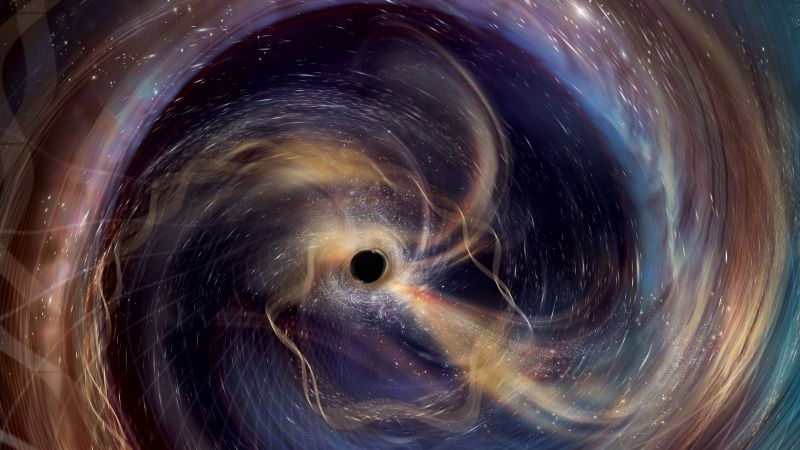
The theory has been proved!
Stephen Hawking's and Albert Einstein's predictions have been confirmed following a 'black hole collision'.
In January this year, astronomers observed two black holes merging in unprecedented detail, validating the long-standing theories of the brilliant physicists.
The cosmic event, named GW250114, was discovered when researchers utilized the two Laser Interferometer Gravitational-Wave Observatories (LIGO) located in Louisiana and Washington.

The instruments detected gravitational waves, subtle ripples in space, resulting from the collision of two black holes, reports CNN.
Einstein first predicted this phenomenon in 1915 as part of his theory of relativity, identifying the search for gravitational waves as the sole method of detecting black hole collisions from Earth.
Nonetheless, the theoretical physicist believed that technology would not be able to detect the signals, as they would probably be too faint to be observed.
In 1971, British physicist Hawking introduced his own theory regarding black holes, suggesting that when two of them merge, the resulting surface area must be equal to or larger than that of the original.
Jump to September 2015, when LIGO made history by capturing the waves for the first time, leading to a Nobel Prize for the three scientists responsible for the 'black hole telescope' development.
Now, a decade later, scientists are celebrating another significant breakthrough with the discovery of two black holes in greater detail.
Maximiliano Isi, an assistant professor of astronomy at Columbia University and an astrophysicist at the Flatiron Institute’s Center for Computational Astrophysics in New York City, described how the black holes had a mass about 30 to 35 times that of the sun and were rotating slowly.

“The black holes were located about 1 billion light-years away, orbiting each other in an almost perfect circle,” Isi stated. “The resulting black hole had a mass approximately 63 times that of the sun and was spinning at 100 revolutions per second.”
He added: "However, with the significant improvements in instruments since then, we can now observe these two black holes with much greater clarity as they approached and merged into one."
Isi asserts that the latest observation provides the team with a fresh perspective on 'the dynamics of space and time.'
“Indeed, black holes are mysterious, complex, and hold significant implications for the evolution of the universe,” Isi continued, “yet mathematically, we believe they can be fully described by just two numbers.
"Everything about them should be determined by their size — or mass — and their rotation speed.”
To determine its size, the scientist explains that researchers utilize LIGO's features to induce a 'ringing' or vibration.
He further explained: "If you strike a bell with a hammer, it will produce a ring."
"The pitch and duration of a sound reveal information about the material of a bell. Similarly, black holes emit gravitational waves when they 'ring.'
“We discovered two components of this ringing, enabling us to confirm that this black hole can indeed be characterized by just two numbers: mass and rotation,” he explained.
“This is crucial for our comprehension of space and time, as black holes are expected to be featureless in a certain way. It's the first time we've observed this so convincingly.”
Featured Image Credit: Aurore Simonnet (SSU/EdEon)/LVK/UR


Comments